
An introduction to authentic Gaelic folk magic & the traditional mechanics of Highland witchcraft
This article gives great authentic & obscure details for traditional witches and other modern practitioners looking for real historical practices and rituals to enhance their craft.
Modern witchcraft practices and practitioners come in a wide variety of types.
But for those who are practicing more traditional crafts - that is, those grounding their rituals in authentic, non-Wiccan history - learning the magical properties of herbs and days of the week is only the beginning.
Alongside other old practices like those of the British Cunning Folk, traditional Gaelic magic is one of the richest surviving sources of practices available to modern audiences.
The beliefs and customs discussed here have survived for centuries by being passed down orally among the rural peasantry of the Gaelic regions (especially the Highlands of Scotland) until they were finally recorded by nineteenth-century folklorists
And now I'm bringing them to you. Read on for all the details.
Published: 14th Mar 2026
Author: Sian H.
The ‘Caim' or the circle of protection
While modern witchcraft practices often involve casting a circle before a lengthy ritual, historical accounts show the old Highlanders used a faster, practical method for immediate defense called the caim (sanctuary).
When facing sudden fear or an evil spirit, they drew an imaginary circle in the air around themselves with their hand. Local legends claimed this invisible barrier held enormous power.
In one story, a young woman tending sheep was approached by a suitor. He attempted to win her over by transforming sheep droppings into gold.
But, she noticed that he had hooves instead of feet and water-weeds in his hair, identifying him as the water-horse (Kelpie) her mother had warned her about.
The woman reported this back to her family and the local priest was called. The priest brought a holy book and traced a caim around the woman, invoking the Trinity.
When the disguised water-horse returned, he walked around the boundary three times but was unable to cross it.
Finally, a rooster crowed, causing the creature's disguise to break. He fleed, shooting flames from his head and heels and the gold in the woman's hand turned back in to sheep droppings.
Glamours and invulnerability or the Sian & Fath-Fithe
In traditional Gaelic magic there was a specific form called the Fath-Fithe (also Fith-Fath), an occult power used to cast a glamour of invisibility over a person, rendering them unseen to mortal enemies or evil spirits.
Achieving this, or casting a Sian (a protective shield of invulnerability), required a physical two-person ritual.
One of the rituals described said that the "charmer" laid a hand upon the recipient's head and, with their own eyes tightly shut, walked around the kneeling person sunwise (deiseal) to invoke lucky energies and then anti-sunwise (tuaitheal) to bind the shield.
To take effect, this elaborate physical pacing required the accompanying "charm of the seven paters" to be chanted during the circling.
Knot magic
Gaelic folk magic frequently used cords, particularly the "Eolas an t-Snaithnean" (the charm of the triple threads).
Malefic practitioners would use knot magic for different purposes, for example, to curse a rival's marriage bed. To cast the spell, they took three threads in three different colors and tied three running knots into them.
To trigger the curse, the practitioner waited in the church and pulled the knots tight at the exact moment the priest declared the couple wed.
The traditional counter-mechanic to block this curse was equally physical: the bridegroom had to stand at the altar with one shoe completely untied and a silver sixpence placed beneath his bare foot to ground out the dark energy.
The shamanic diagnosis of the Evil Eye
In Gaelic lore, the Evil Eye was a severe physical affliction.
Victims might suffer from various sudden maladies, unnatural yawning, violent vomiting and causing their face to become "grim, gruesome, and repulsive".
There were a number of rituals recorded to diagnose and cure this curse (in fact it was probably one of the charms most diversely recorded).
In one example, a healer gathered water in a wooden ladle from a stream crossed by both the living and the dead, strictly avoiding metal during the collection.
The healer then dropped a wife's gold ring, a piece of silver and a piece of copper into the water. After blessing the water and anointing the victim, the healer turned the wooden ladle upside down to divine the attacker's identity.
If the copper piece stuck to the bottom, the attacker was a man; if the gold or silver stuck, it was a woman.
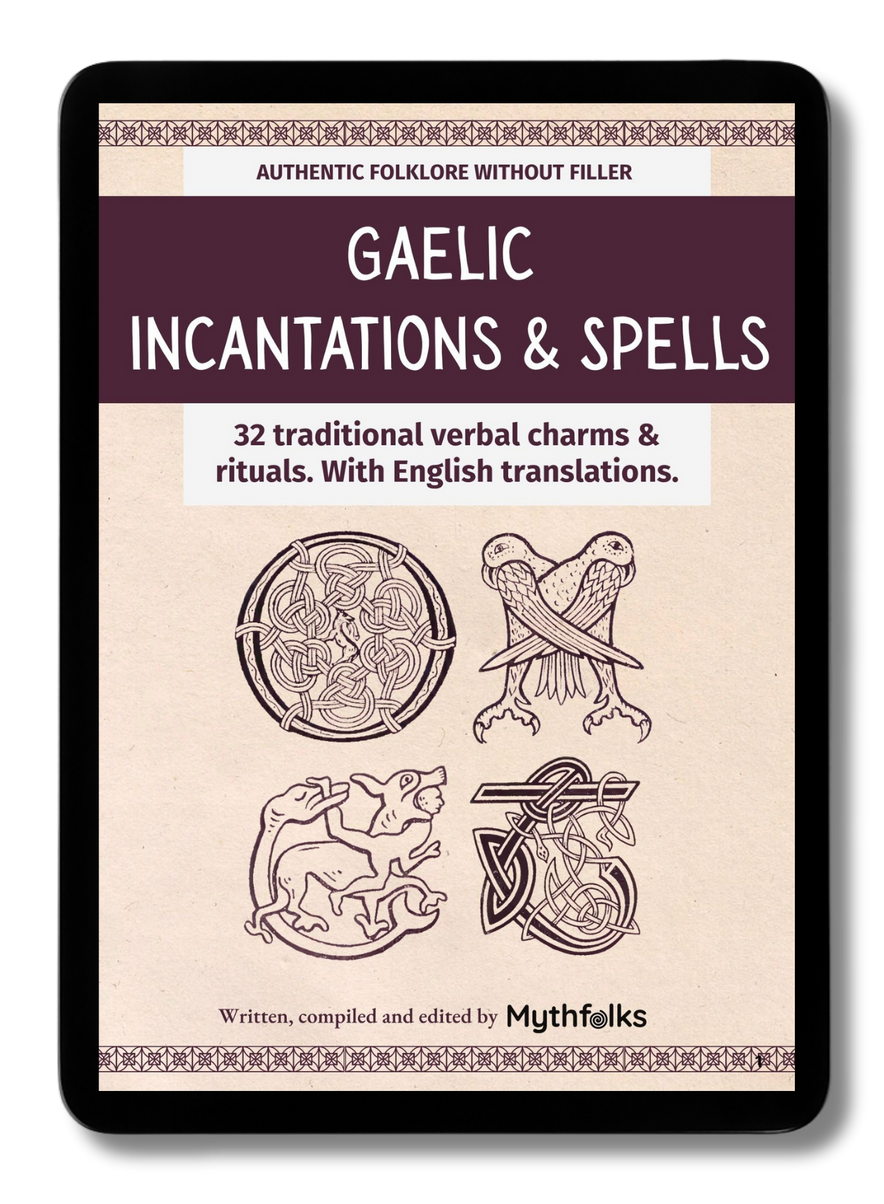
Want original Gaelic incantations and rituals?
If authentic folklore and historical accuracy is critical to your magic practice or project, my NEW & EXCLUSIVE ebook has got you covered.
Featuring 30+ traditional incantations in Gaelic (with English translations) and curated from primary sources captured in the late 19th-century.
You'll find verbal folk magic charms that cover everything from protection spells and becoming invisible and invulnerable, to finding love, obtaining justice and blocking supernatural magic.
(Clicking the link will open the Mythfolks Etsy shop in a new tab.)
Harvesting rules for plant magic
In folklore, traditional plant magic in the Highlands followed strict harvesting rituals. Gathering a plant at the wrong time or in the wrong posture could render it magically dead.
- The Torranan (Figwort): Used to ensure abundance, this plant possessed a magical tie to the sea. It required harvesting during a rising tide to fill it with the ocean's "milk of grace." Picking it during an ebbing tide drained its power away with the water.
- The Mothan (Bog-Violet): Considered a supreme magical plant for love-binding, creating a love-philtre from it required specific physical actions. A practitioner had to kneel on her left knee to pluck nine roots. She knotted these roots into a ring (cuach) and placed it in a young woman's mouth. A kiss from her desired man while the plant remained in her mouth bound him to her forever.
- The rule of the accidental find: While some plants required strict lunar or tidal timing, the Achlasan-Chalum-Chille (St. John's Wort) required a complete lack of intention. Considered a supreme ward against the Evil Eye and second sight, its occult power activated only when stumbled upon entirely by accident - "unsought-for and unasked." Once found, the practitioner secretly sewed it into the left armpit of their clothing, chanting a specific consecration over the leaves.
The Toisgeal, written amulet
While most spells were spoken, traditional Gaelic healers also sometimes used a written charm called a Toisgeal.
The charmer wrote a highly secret magical formula on a small piece of paper, folded it up, and sewed it into the undergarments of the sufferer.
As long as the paper remained intact, the person remained shielded from their affliction.
However, this carried a strict rule: the wearer had to keep the paper permanently sealed. Opening the paper and reading the words instantly broke the magic, causing the curse or sickness to immediately return.
The 'Frith' or opening the sight
To locate a missing community member or valuable animal, the people used the frith, an ancient form of threshold omen.
One recorded ritual required a performance on the first Monday of the new quarter, right before sunrise.
The seer adhered to strict physical requirements: remaining entirely fasting, barefoot, and bareheaded.
They stood at the doorstep of their home, placed a hand on each door jamb, closed their eyes and prayed.
Upon opening their eyes, the very first omens crossing their path - a bird, a beast or a shadow - revealed the exact fate of the lost soul.
Article sources
- Mackenzie, William. Gaelic Incantations, Charms and Blessings of the Hebrides: With Translations, and Parallel Illustrations from Irish, Manx, Norse, and Other Superstitions. Inverness: Northern Counties Newspaper and Printing and Publishing Company, Limited, 1895.
- Carmichael, Alexander. Carmina Gadelica: Hymns and Incantations with Illustrative Notes on Words, Rites, and Customs, Dying and Obsolete: Orally Collected in the Highlands and Islands of Scotland and Translated into English. Vol. 2. Edinburgh: Printed for the author by T. and A. Constable; sold by Norman Macleod, 1900
Want original Gaelic incantations and rituals?
If authentic folklore and historical accuracy is critical to your magic practice or project, my NEW & EXCLUSIVE ebook has got you covered.
Featuring 30+ traditional incantations in Gaelic (with English translations) and curated from primary sources captured in the late 19th-century.
You'll find verbal folk magic charms that cover everything from protection spells and becoming invisible and invulnerable, to finding love, obtaining justice and blocking supernatural magic.
(Clicking the link will open the Mythfolks Etsy shop in a new tab.)
You might also like
The British cunning folk
These traditional healers faced all kinds of dangers and followed many different types of practices. Learn all about them here.
A history of witches in folklore
From ancient myths to the famous witch trials, take a step back in time and take a quick tour through witch folklore.
Types of witchcraft & their folkloric roots
From the ancient seers to modern practitioners, take a tour through the broad range of witch practices throughout history.
Modern witchcraft & its origins
Much of today's witchcraft is based on the past - but not all of it. Learn more about the major contemporary witchcraft practices.