
Traditional charms and spells of the British cunning folk - sourced directly from a 16th century text
This article gives great authentic & obscure details for traditional witches and other modern practitioners looking for real historical practices and rituals to enhance their craft.
If you’re feeling frustrated with all the superficial Social Media witchcraft content - this one’s for you.
While some modern witch practices focus on learning and finding your own path, dominant trends tend to focus almost completely on aesthetics and "witchy looks".
Which obviously isn't helpful if you want to get a real look at understanding the past...
Traditional witchcraft was all about survival. Both for the practitioner and the people they were supposed to be helping.
Protection from “evil” witches, healing from disease, finding people who had stolen from you - these were the kinds of things that people regularly sought help with. And the cunning folk of Britain were all too willing to offer their services.
The written records of these traditional spells are limited and hard to find - but not to worry, because I enjoy digging for these kinds of details!
If you want to understand more about how the traditional
witch practices of the past really worked, take a look at these examples below - they've been carefully dug out and preserved from a dense book that was originally published in 1584...
Published: 9th Jul 2026
Author: Sian H.
About these charms
The charms recorded in the 1584 source text - The Discoverie of Witchcraft by Reginald Scot - were gathered from a variety of sources (including many very old ones) and the specific contributions weren't always clear, but they are a good reflection of cunning folk practices at the time. While this information would have been relevant across Britain, as Scot was English it would have likely had an English/Welsh slant. But there are also additional texts that recorded other specific
traditional Gaelic charms that primarily came from Scotland - read more here.
Scot wrote the book specifically to try and counteract the ongoing witch craze and trials happening during his lifetime. He viewed the entire practice of witchcraft as impossible and absurd - whether "evil" or "good" magic, for him it was all the same - no one should be prosecuted or executed for witchcraft because it didn't really exist.
What he also did was to leave behind a wealth of fascinating detail from the past - about how people practiced folk magic, the spells and incantations they used, the rituals they performed and by-proxy, the beliefs that people held.
The original edition was written in Elizabethan English. Where words appear below in “” these have been transcribed as written in the original source. But for readability purposes, the old letter “s” that looked like an “f” has been replaced and “u” and “v” have been swapped i.e the text originally said “vpon” instead “upon” and “foon” instead of “soon” etc.). Rituals and descriptors have been paraphrased in modern English to keep everything accessible.
Charm to tell whether someone is bewitched
Hold molten lead over the sick person and then pour it into a shallow bowl containing water. If any image appears on the lead in the bowl, you will know that the person has been cursed by a witch
Charm to curse someone who has stolen something
[This particular charm was directed at a thief who had stolen some fish.]
On Sunday, stand in the church pulpit wearing a white church robe and a scarf around your neck.
Speak these words to the crowd to curse the people who stole the fish:
"All you that have stolne the millers eeles
Laudate Dominum de cælis,
And all they that have consented thereto,
Benedicamus Domino."
Charm for protection
Carrying a copy of the Epistle of St. Savior, was said to guarantee daily physical protection from iron weapons, fire, drowning, evil men and dangerous creatures.
There’s not a huge amount of information on the Epistle, but this was said to be a part of it:
“The crosse of Christ is a woonderfull defense, the crosse / of Christ be alwaies with me, the crosse is it which I doo alwaies worship, the crosse of Christ is true health, the crosse of Christ dooth lose the bands of death, the crosse of Christ is the truth and the waie, I take my journie upon the crosse of the Lord, the crosse of Christ beateth downe everie evill, the crosse of Christ giveth all good things, the crosse of Christ taketh awaie paines everlasting, the crosse of Christ save me, O cross of Christ be upon me, before me, and behind me, bicause the ancient enemie cannot abide the sight of thee, the crosse of Christ save me, keepe me, governe me, and direct me, Thomas bearing this note of thy divine majestie, Alpha, Omega, first and last, middest, and end, beginning, and first begotten, wisedome, vertue”
Charm for a pardon of sins
Found in a 1516 York prayer book titled The Hours of Our Lady, this charm was meant to give a church-sanctioned pardon offering a -very precise (!) - reduction of 32,755 years in Purgatory.
To activate it the practitioner had to look at these words on a piece of paper:
“Signum sanctæ crucis defendat me à malis præsentibus, præteritis, & futuris, interioribus & exterioribus: that is, The signe of the crosse defend me from evils present, past and to come, inward and outward.”
And recite the Lord’s Prayer 5 times, Hail Mary 5 times and the Creed once.
[In the source text, Scot included a sarcastic side note here that failing to count the prayers ruined the magic and he speculated this indulgence dated back to Pope Boniface IX when such pardons were sold so cheaply they became a complete joke. He made these asides regularly and it's likely that the number 32,755 was input to highlight his incredulousness at the idea of the charm.]
A charm to make a counterfeit anointing oil
This charm was another Catholic ritual intended to counterfeit the holy anointing oil originally created by Moses.
It was used to get rid of the devil and invite the Holy Ghost in, instead. The ritual was to blow a cross in the air 3 times - so hard you feel like you could vomit - bow or curtsey 3 times and say:
“Ave sanctum oleum, ter ave sanctum balsamum.”
“An old womans charme, wherewith she did much good in the countrie, and grew famous thereby.”
(Or, a charm used by an old woman who became famous in the countryside for doing a lot of good!)
The old woman of the title was seriously questioned about how she had apparently healed all kinds of sick cattle.
She confessed that after touching the sick animal, she would leave immediately and say:
“My loafe in my lap,
my penie in my pursse;
Thou are never the better,
and I am never the wursse.”
Charm for resting the body or spirit
Recite these words to help recuperate:
“In nomine patris, up and downe,
Et filii & spiritus sancti upon my crowne.
Crux Christi upon my brest,
Sweete ladie send me eternall rest !”
And one for luck…
Charm to stop a storm
Witches were popularly accused of causing bad weather, but this could be countered by:
Throw a black chicken up into the air and this will stop the storm immediately!
Article sources
- Scot, Reginald. The discouerie of witchcraft, 1584
- Scot, Reginald. The Discoverie of Witchcraft. Edited by Brinsley Nicholson. London: Elliot Stock, 1886.
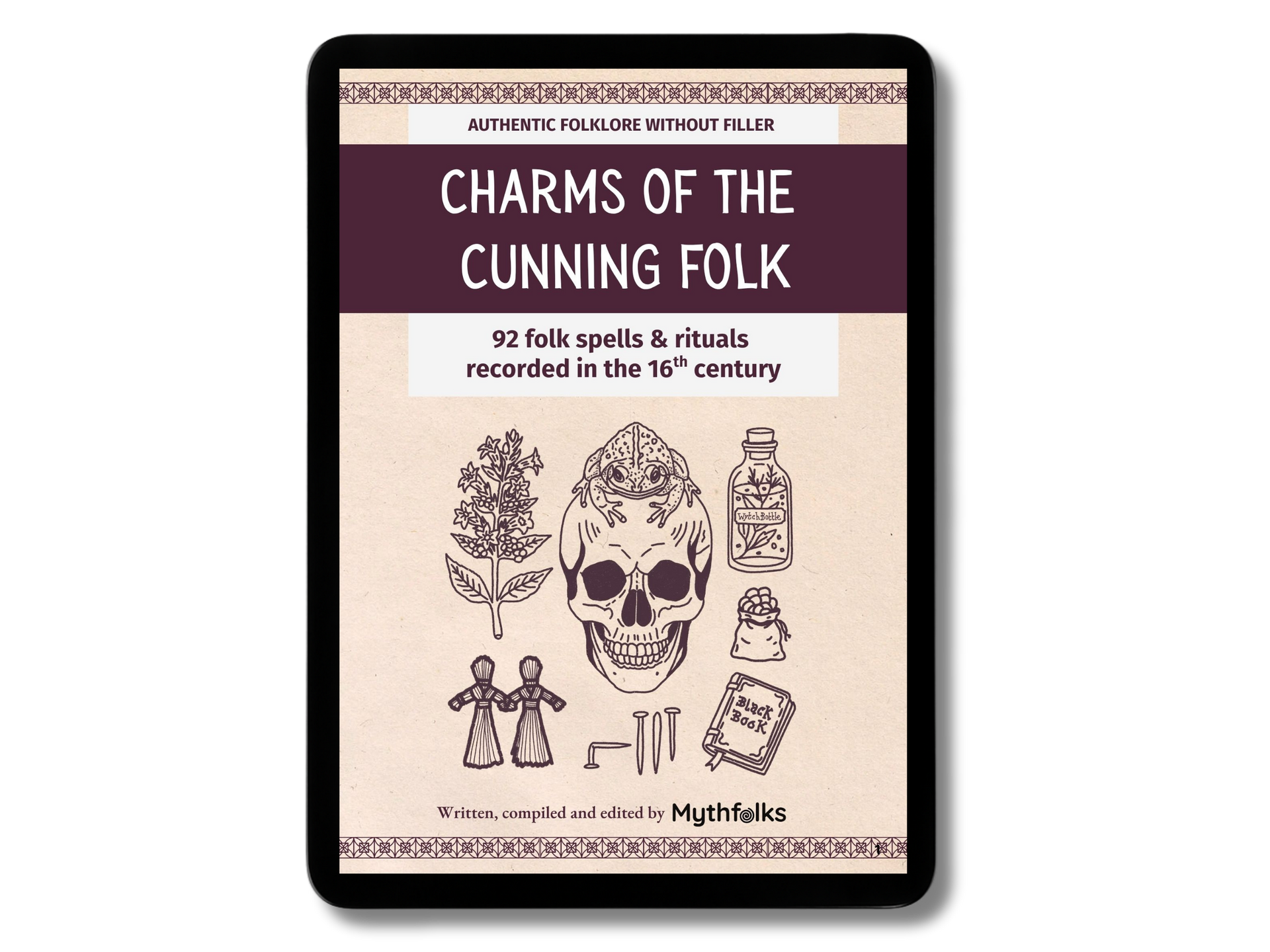
Want another 92 authentic cunning folk charms you can use straight away?
If you enjoyed this article but want all the details, I’ve compiled a comprehensive collection of 92 original charms of the cunning folk in a handy PDF, that’s easy to scan and use.
From protection against witchcraft and the supernatural, to remedies for ills, gathering herbs and plenty more, you'll find a fascinating round-up of authentic spells preserved with (where applicable) the original spoken or written words.
You’ll find some additional context on the 16th century source and the background of the charms, plus bonus content about the purported magical properties of 22 precious stones as recorded at the same time. Take a look here for more info and to buy.
(Clicking the link will open the Mythfolks Etsy shop in a new tab.)
You might also like
The British cunning folk
These traditional healers faced all kinds of dangers and followed many different types of practices. Learn all about them here.
A history of witches in folklore
From ancient myths to the famous witch trials, take a step back in time and take a quick tour through witch folklore.
Types of witchcraft & their folkloric roots
From the ancient seers to modern practitioners, take a tour through the broad range of witch practices throughout history.
Traditonal Gaelic folk magic
Much of today's witchcraft is based on the past - but not all of it. Learn more about the major contemporary witchcraft practices.